 |
Chief Crowning Ceremony in Swaziland
Dirt roads aren't so bad when you're in a reasonable vehicle, I thought as the new LandCruiser sped through the Swazi countryside. My three-point seatbelt was fastened; air conditioning flowed; conversations were maintained. Why have I squandered the past 12 months in rattling, claptrap, death's door minibuses?
I was heading to the Bhekinkos chiefdom in rural Swaziland with five United Nations workers. As we glided through the foggy mountain kingdom my hosts gave me a crash course in Swazi politics and customs to prepare me for the day's event, the crowning of a new Chief.
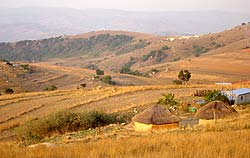 |
we glided through the foggy mountain kingdom |
The smallest country in the Southern Hemisphere, Swaziland is one of the last remaining monarchies in Africa. His Majesty King Mswati III is at the head of state, and he and his Council of Ministers oversee two governing systems. A parliament, senate, and Assembly control the economic and official side of the country. Running parallel to this is the Tinkhundla system, consisting of Chiefs and liaisons to the King, which tends to the affairs of the people.
Swaziland is broken up into 55 constituencies, each of which contains 10-15 chiefdoms. Governing on behalf of the king, the Chiefs provide guidance and leadership for their people, settle disputes, allocate land, and direct ceremonies. For the average Swazi, the Chief is their main contact with the government and the King.
The Chief's Homestead
A preacher led hundreds of people in prayer when we arrived at the Chief's homestead;
fiery, prolonged sermons in Siswati, the Swazi language, were punctuated by
"Hallelujahs" and "Amens" from the crowd. More than 100
guests sat beneath a giant canvas tent. Hundreds more sat in a semicircle around
the front of the tent, leaving an open area for a stage.
Made up of traditional stick and mud huts and a few brick buildings, the homestead was situated high on a hill and overlooked a rolling, cultivated valley. Crowds of people buzzed around the compound. Hanging together in small clusters were members of the Chief's regiment, traditional warriors dressed in leopard skin loin cloths, leather straps, and beadwork; they carried sticks, spears and, in a few cases, cell phones.
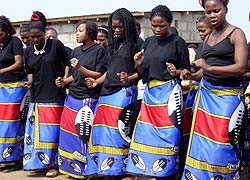 |
the women's choir belted out beautiful gospel songs |
At the center of the homestead was the kraal, a circular pen for the animals. Khulile, a young Swazi technology worker for the UN, explained the ritualistic significance of the kraal in Swazi homesteads. "It has to do with the animals, which are at the heart of the homestead," she said. "If somebody dies, part of the ceremony takes place in the kraal. It's the same with marriages and other celebrations." Much of the action today was to take place around the kraal.
Stumbling Into the Extraordinary
Jordan, a Canadian I met in a backpacker's hostel in Mbabane, the capital of
Swaziland, told me about the Chief crowning ceremony. An intern for the UN,
Jordan and his coworkers were attending this event as part of their development
program. After a little finagling it was decided that I could tag along and
video the proceedings on the condition that I provide the UN with a copy of
my footage. This association proved to be auspicious. I was transformed from
an obscure American traveler to a United Nations photographer, and given an
all-access pass to the event. The former Indvuna, or Head Man of the
constituency, went out of his way to alert people to my presence, and he encouraged
me to follow the Chief-to-be closely and capture as much of the proceedings
as possible.
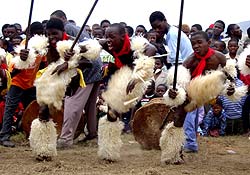 |
the men's dance troupe performed acrobatic stunts |
The celebration began with a children's choir. Thirty kids dressed in black and red sang a series of traditional songs with stern, focused expressions and obvious pride.
Next came a men's dance troupe. Accompanied by drummers on large, leather-skinned drums, the young men participated in fierce mock battles, performed acrobatic stunts, and incorporated elements of slapstick that had the crowd howling.
A women's choir followed. Dressed in blue sarongs adorned with the Swazi flag, the ladies belted out beautiful gospel songs and performed choreographed steps. Two old grannies from the crowd, clearly intoxicated, adorned with rattling shells around their ankles, livened up the performance with spontaneous, comical dancing.
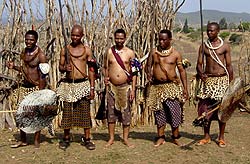 |
members of the Chief's regiment |
I was greeted warmly as I wandered around the homestead. Elderly men gave me prolonged handshakes and thanked me for being there. Children followed me and tried to get in the scenes I was shooting. Members of the Chief's regiment gave me stern half-smiles. Warm nods and smiles came from the old ladies. When folks asked why I was there I casually explained that I was "with the UN."
"Cameraman, they're looking for you," a man in the crowd said.
The Head Man asked me to get my things ready; the Chief was about to emerge from the ingcamu, the central hut in the homestead, where he'd been holding counsel with his regiment and advisors.
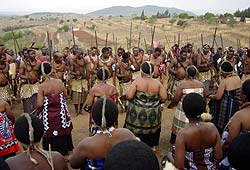 |
congregation in front of the kraal |
A man of about 30, the Chief-to-be wore a serious, sometimes uncertain expression. This was the most important day of his life. He was acquiring great power and tremendous responsibility. The occasion was no doubt infused with sadness as well, for he was assuming this role after the death of his father.
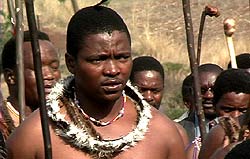 |
The young Chief-to-be wore a serious, sometimes uncertain expression |
At the end of the ceremony, the Chief-to-be's uncle handed him a spear and scepter, a symbolic transfer of authority. Officially crowned, the Chief and his regiment paraded through the kraal and into the crowd.
A Brush With Royalty
Eight cows had been slaughtered for the celebratory feast. Hundreds of people
lined up to be served out of giant iron cauldrons. The Chief and his regiment
ate at long tables under canvas canopies.
"Mike, come over here," Jordan said as the feast was underway. He and the other UN workers lined up before the Chief's table.
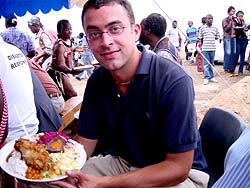 |
a feast fit for a Chief |
After the introductions the UN folks and I were seated at a table near the Chief and his inner circle. Standing nearby, the ladies choir serenaded us. A grinning woman presented me with a plate piled with maize, salad, beans, roast beef, and fried chicken. The late afternoon sun lit the homestead and the mountains in the distance warmly. I grabbed a plastic spoon and went to work. It was a feast fit for a Chief.
What do you think? |
|